

- Home
- News
News
State of Lake Superior Conference proceedings available
Jan 31, 2019
Proceedings from the 2018 State of Lake Superior are now available online.
Critical Update: GLFC FY2020 Call for Proposals
Jan 25, 2019
Due to the Great Lakes Fishery Commission Research Program’s funding cycle, we are unable to further extend our FY2020 Call for Proposals beyond January 29, 2019 11:59PM (EDT). As such, pre-proposals will be affected by the partial U.S. government shutdown.
IAGLR seeks coordinator for 2019 State of Lake Huron Conference
Jan 24, 2019
We are seeking proposals from qualified and highly motivated contractors or organizations to coordinate the State of Lake Huron Conference scheduled for early October 2019 at Saginaw Valley State University, in Saginaw, Mich. For details, please view the Request for Proposals. Proposals due Feb. 8.
Call for Lifetime Achievement Award nominations
Jan 23, 2019
The IAGLR Lifetime Achievement Award recognizes important and continued contributions to the field of Great Lakes research over a period of 20 years or more. Please consider nominating a deserving candidate! Deadline March 31. Download Flyer
US federal government shutdown and Great Lakes research
Jan 21, 2019
As the partial U.S. federal government shutdown enters its fifth week, the association is aware that many of its members are being personally and professionally affected by the inability to work and get paid. Although it is unclear when the shutdown will end, IAGLR would like to know if you’ve been affected and what support the association can offer. Read on for more information.
IAGLR19 Call for Abstracts: deadline extended for federal employees
Jan 21, 2019
IAGLR has fielded many inquiries about the U.S. federal shutdown and its impact on the IAGLR19 Call for Abstracts. We sympathize with our U.S. federal colleagues and have developed a plan to address these concerns.
Call for nominations for Vallentyne outreach award
Jan 15, 2019
Do you know someone who has contributed substantially to education and outreach in the great lakes community, including North American Great Lakes, African Great Lakes, or others? We're soliciting nominations for the 2019 John R. (Jack) Vallentyne Award. View the Call for Nominations and submit your nominee by March 10.
US federal shutdown and abstract submission
Jan 7, 2019
We are aware that the US federal government shutdown may affect some IAGLR 2019 conference participants. We are assessing the situation and may delay the abstract deadline to accommodate; however, at present the deadline to submit an abstract remains as Feb. 1.
International Travel Award available for IAGLR 2019
Jan 7, 2019
Students outside US & Canada may be eligible for an International Travel Award to attend the IAGLR 2019 conference in Brockport, NY, this June. Application deadline is March 1.
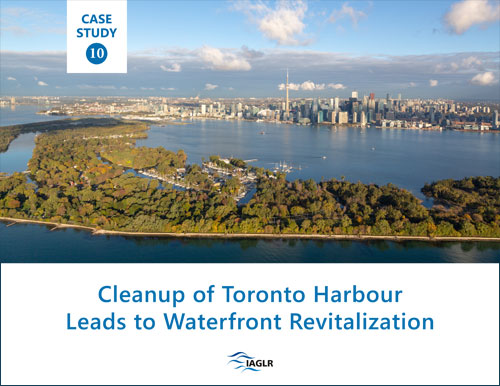
Harbor cleanup drives Toronto’s waterfront revitalization
Jan 3, 2019
After decades of underuse and neglect, Toronto’s waterfront has emerged as a vibrant gathering space that draws people to the shores of Lake Ontario. Decades of cleanup efforts and collaborative planning are behind this turnaround, which has resulted in significant ecological and economic benefits, according to a report released today by the International Association for Great Lakes Research.
New case study on St. Louis River AOC
Dec 17, 2018
With Lake Superior at its front door, the community of Duluth, Minnesota, traditionally overlooked the St. Louis River, which empties into the lake at the site of the country's largest dry bulk port. The river historically supported heavy industry along its banks, which took a heavy toll on the ecology and health of the river.Today, efforts turned to cleaning up a legacy of impaired water quality and associated economic losses. Learn more about the turn-around in Duluth in the new case study titled From Remediation to Restoration and Revitalization: The St. Louis River Story.
2019 Memberships Underway
Dec 14, 2018
We anticipate an exciting year approaching -- one you'll want to participate in. 2019 membership benefits include the J. of Great Lakes Research, and also entitles you to discounted registrations for the upcoming 62nd annual Conference on Great Lakes Research, and State of Lake! Visit IAGLR Portal
New member? Simply create a profile, select JOIN, and pay for the appropriate membership type.
Aquatic Scientists Push Back Against Narrow WOTUS Rule
Dec 11, 2018
Through the Consortium of Aquatic Science Societies, IAGLR and our fellow societies issued a statement expressing our deep concern with the proposed rule issued today by the EPA and the U.S. Army Corps of Engineers to replace the 2015 Clean Water Rule (Waters of the United States Rule or WOTUS).
JGLR 44(6) is out, with special section on the 2017 African Great Lakes Conference
Dec 11, 2018
The Journal of Great Lakes Research, Volume 44, Issue 6, is now online. The issue features a special section titled 2017 African Great Lakes Conference: Conservation and Development in a Changing Climate. Guest editors are Harvey Bootsma, Patrick Doran, Leo Nagelkerke, Modesta Medard, Stephanie Guildford, and Robert Hecky.
Seeking outreach excellence; Vallentyne Award call for nominations opens
Dec 10, 2018
Do you know someone who has contributed substantially to education and outreach in the great lakes community, including North American Great Lakes, African Great Lakes, or others? We're soliciting nominations for the 2019 John R. (Jack) Vallentyne Award. View the Call for Nominations and submit your nominee by March 10.
IAGLR19 Call for Abstracts
Dec 5, 2018
We invite you to submit an abstract to present at the 62nd annual Conference on Great Lakes Research, to be held June 10-14, 2019, at The College at Brockport, State University of New York. Fifty-eight sessions have been proposed to complement the theme Large Lakes Research: Connecting People and Ideas. We welcome abstract submissions for both oral and poster presentations. View the Call for Abstracts for details. Submission deadline is Feb. 1, 2019.
The gift that gives twice - an IAGLR donation
Nov 28, 2018
It’s that time of year when we all think about giving gifts to those who are important to us. It’s also a time when we consider charitable giving. IAGLR is an official 501(c)(3), which means that contributions to IAGLR are tax-deductible* against U.S. income tax and may be deductable against U.S. earnings in Canada. IAGLR maintains an Endowment Fund for special projects and as a “rainy day” fund to cover emergency expenses. We also sponsor several annual student scholarships and awards.
Perhaps you can help IAGLR, while minimizing your taxable liabilities? We appreciate the many ways YOU support the Association! Thank you!
Buffalo River AOC case study showcases rebirth of “Queen City of the Great Lakes”
Nov 26, 2018
The Buffalo River has gone from a severely degraded waterway to one of Buffalo's greatest assets. Decades of industrial and municipal contamination had overwhelmed the river, even resulting in a fire on the river in 1968. Named as one of the Great Lakes most polluted waterways in the 1980s, the river has since undergone a substantial cleanup effort fostered by public-private partnerships, and in recent years, federal funding from the Great Lakes Legacy Act and the Great Lakes Restoration Initiative. Now the river attracts new developments and provides a popular destination for all sorts of recreational opportunities. Learn more about this recovery in our latest report in our series that evaluates achievements and lessons learned from 32 years of efforts to clean up Great Lakes AOCs.
Funds available to support collaborative research on Lake Michigan coastal dynamics
Nov 5, 2018
The Lake Michigan Sea Grant programs, including Wisconsin Sea Grant, Michigan Sea Grant and Illinois-Indiana Sea Grant, seek integrated proposals to better understand coastal hydrodynamics and nearshore sediment transport processes on Lake Michigan, to help effectively communicate this information to promote sustainable shore protection, and to increase the integrity of beaches and stabilize bluffs. The result would be more resilient coastal communities and economies.
Full guidance for the RFP, including what project details to provide and where to provide them, can be found here: http://www.iiseagrant.org/newsroom/wp-content/uploads/2018/11/JointRequestForProposals-MI-II-WI_Final.pdf. The deadline for preproposals is Friday, January 11, 2019, 3 p.m. CST (4 p.m. EST).
For more information:
Wisconsin Sea Grant: Jennifer Hauxwell (jennifer.hauxwell@aqua.wisc.edu, 608-262-0905)
Michigan Sea Grant: Catherine Riseng (criseng@umich.edu, 734-936-3622)
Illinois-Indiana Sea Grant: Carolyn Foley (cfoley@purdue.edu, 765-494-3601)
New case study on Cuyahoga River AOC
Oct 26, 2018
The Cuyahoga River has come a long way since 1969, when its burning waters thrust it into the national spotlight. This potent symbol of environmental degradation galvanized an environmental movement, inspiring passage of the Clean Water Act and the U.S.-Canada Great Lakes Water Quality Agreement in 1972. Designation as a Great Lakes Area of Concern in 1985 led to continued remediation and restoration efforts that resulted in a return of fish, peregrine falcons, eagles, and osprey. This cleanup and river revival led to the revitalization of The Flats district at the mouth of the river in Cleveland. The city's center of industry and commerce during its industrial heyday, the Flats is now a unique urban neighborhood where nature, commerce, and industry live together. Learn more about this recovery in a new report.
Propose a session for IAGLR 2019
Oct 23, 2018
Interested in organizing a scientific session for IAGLR 2019 in Brockport, NY? The Call for Sessions is now open. Researchers will gather June 10-14, 2019, for the 62nd annual Conference on Great Lakes Research, to be held at The College at Brockport, State University of New York. In keeping with the conference theme Large Lakes Research: Connecting People and Ideas, we welcome sessions that integrate and connect disciplines and ideas within the trophic web, including invasive species, watersheds and lake water quality, and climate change. The call includes examples of session topics, but we are not limited to those listed. If you don't see what you want to hear about, take this opportunity to propose new and interesting relevant topics. We welcome and encourage other session topics! Deadline: November 21, 2018.
JGLR 44(5) is now online; special section on Green Bay Ecosystem
Oct 11, 2018
The Journal of Great Lakes Research, Volume 44, Issue 5, is now online. The issue features a special section titled Recent advances in understanding the Green Bay ecosystem: A scientific foundation for adaptive restoration. Guest editors are John F. Bratton, Kevin Fermanich, Patrick Forsythe, John Janssen, Jerry Kaster, and J. Val Klump.
Join us at State of Lake Superior
Oct 6, 2018
It's not too late to join IAGLR at Michigan Technological University for the.SOLS conference Walk in registrations are welcome! Register late or download the onsite form in advance.
For those attending, we've put together some helpful last minute tipsl! Thanks again for your participation, we're looking forward to a great program.
Big Lakes - Small World ELLS-IAGLR Conference
Oct 6, 2018
The world's large lakes are precious, indeed. IAGLR and the European Large Lakes Symposium co-sponsored an international conference entitled “Big Lakes, Small World” during the week of September 23-28, 2018 at Lake Geneva (Evian, France). The meeting was the first IAGLR meeting held outside North America, and in conjunction with the 5th European Large Lakes Symposium. Watch this inspiring video!
Proposed NSERC program changes cause concern
Oct 4, 2018
IAGLR voices its concern over a proposed initiative to condense several programs at Natural Sciences and Engineering Research Council of Canada into a new Research Partnerships program. In a letter emailed to NSERC, IAGLR President Michael Twiss asks NSERC to consider the impact that eliminating the NSERC Strategic Grants program would have on Great Lakes research. "Doing so would adversely impact important environmental research partnerships with a burdensome cash requirement that makes it challenging to secure vital industry involvement. In addition, these research efforts face the loss of valuable in-kind contributions related to infrastructure (such as ships, aircraft, access to satellite data, expert technical staff) that most university researchers do not have." Please consider sending your comments to rpr@nserc-crsng.gc.ca.
IAGLR
4840 South State Road
Ann Arbor, MI 48108
(734) 498-2007
office@iaglr.org
Discover
Get Involved
Stay Connected


The International Association for Great Lakes Research is a U.S. 501(c)(3) nonprofit organization.
© 2026 International Association for Great Lakes Research